
Outdoor advertising has always worked for a simple reason: people cannot ignore what they see on the way to where they are going.
A billboard along a busy road, a sign outside a shopping center, or a digital display in a high-traffic area puts your business in front of people while they are already out in the world. They may not be looking for you that day. They may not even need your service yet. But seeing your name repeatedly builds familiarity, and familiarity makes a business easier to remember when the need eventually comes up.
That basic principle has remained the same even as outdoor advertising has changed. Static billboards are still widely used, but digital displays have made the medium more flexible. Advertisers can now change messages, run multiple creatives, and adapt campaigns without replacing the physical advertisement.
For local businesses, that combination of visibility, repeated exposure, and flexibility makes outdoor advertising a channel worth understanding before investing in it.
This guide covers what out-of-home billboard advertising is, the different formats available from outdoor billboard advertising companies, why it continues to work for local businesses, how the medium has evolved, how to create an effective outdoor ad, what it costs, and how to get started.
Key Takeaways
- OOH reaches people outside their homes, while on-premise signage reaches them when they arrive at a business.
- Billboards offer scale from a single location, making them especially useful for building visibility across a local or regional market.
- Location is one of the most important parts of a billboard campaign. Traffic patterns, direction of travel, nearby areas, and the audience using the route all influence whether a placement is right for your business.
- Effective billboard creative has to work in seconds. Keep it to one idea, seven words or fewer, one strong visual, and one clear call to action.
- Billboards can strengthen the rest of your marketing. Recognition built through OOH can carry into digital advertising, search, referrals, word of mouth, and future buying decisions.
What Is Out-of-Home Advertising?
Out-of-home advertising, or OOH, is advertising that reaches people when they are outside their homes. It covers everything from large roadside billboards to digital displays, transit ads, street-level signs, and advertising placed in public spaces.
The important distinction is where the advertising is seen.
With OOH, the advertiser chooses a location where the intended audience already spends time. A billboard might reach commuters on a busy highway. A digital display might reach shoppers near a retail district. A transit ad might reach people using a particular route every day.
That makes OOH different from on-premise advertising. On-premise advertising refers to signs and displays placed at the business itself. A restaurant's exterior sign, a storefront sign, or a monument sign at a commercial property are all examples. Their primary job is to identify the business, help people find it, and communicate information at the point of location.
OOH advertising has a different job. It reaches people before they arrive at the business or before they have decided they need the product or service.

| Out-of-Home Advertising | On-Premise Advertising | |
|---|---|---|
| Where it appears | Public spaces away from the business | At the business or property itself |
| Primary purpose | Build awareness, recognition, and reach | Identify, direct, and communicate at the point of business |
| Typical audience | People traveling, commuting, shopping, or moving through an area | People visiting or approaching the property |
| Examples | Billboards, digital displays, transit ads, street-level advertising | Storefront signs, monument signs, channel letters, directories |
| Geographic reach | Can reach people across a defined market or route | Primarily reaches people already near the property |
| Exposure | Repeated exposure as people pass the placement | Exposure when people visit or pass the business |
Types of Out-of-Home Advertising

OOH is a broad category, and the format you choose depends largely on where you want to reach people and how you want them to interact with the message.
| OOH Format | What It Is | Best Used For |
|---|---|---|
| Billboards | Large-format displays placed along roads, highways, and other high-traffic routes | Building broad local awareness and keeping a business visible to commuters |
| Digital Billboards | LED displays that can show multiple advertisements and change throughout the day | Flexible campaigns, multiple messages, time-sensitive offers, and frequent creative changes |
| Transit Advertising | Ads placed on buses, trains, taxis, and other forms of public transportation | Reaching commuters and people who regularly use specific routes |
| Street-Level Advertising | Smaller displays placed at eye level in areas with pedestrian or vehicle traffic | Reaching people in commercial districts, downtown areas, and high-foot-traffic locations |
| Wallscapes | Large advertisements installed directly on building walls or other prominent structures | Creating high-visibility placements in dense urban or commercial areas |
| Place-Based Advertising | Displays placed in locations such as shopping centers, airports, gyms, or other high-traffic venues | Reaching a more specific audience based on where they spend time |
While these formats look different, they all rely on the same basic advantage: putting a message into the physical environment where people already spend time.
For a local business, the right format usually comes down to three things: who needs to see the message, where those people are, and how often they can be reached there.
What's a Billboard in Out-of-Home Advertising?
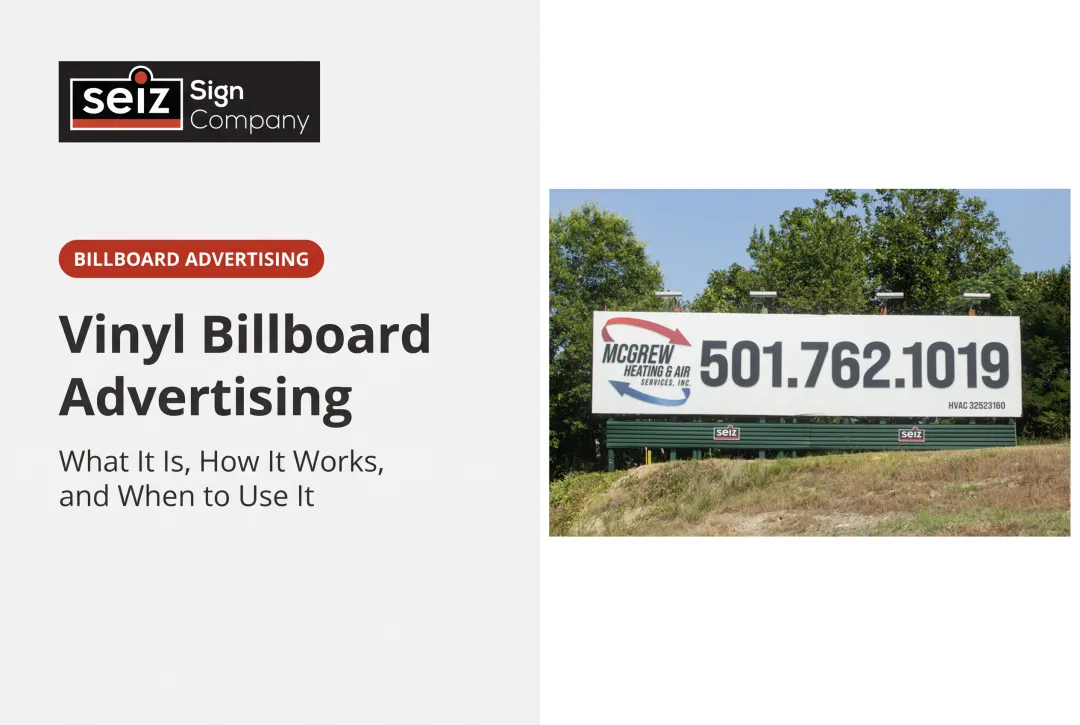
A billboard is one of the largest and most recognizable forms of out-of-home advertising. It is a large-format advertising display placed in a location where people can see it as they travel, typically along busy roads, highways, and major traffic routes.
Unlike on-premise signs, which identify and communicate information about a business at its own location, billboards are positioned away from the business to reach people throughout the surrounding market. The goal is to put a business, product, service, or message in front of a large audience while they are already traveling through the area.
Billboards can be static or digital. Static billboards use printed graphics that remain in place for the duration of the campaign, while digital billboards use electronic displays that can rotate multiple messages and change throughout the day.
Also read: Benefits of Static Billboard Advertising for Local Businesses in 2026
Why Choose Billboards Over Other OOH Formats?
Out-of-home advertising gives you plenty of ways to reach people, so choosing a billboard shouldn't come down to the fact that it's the biggest format. The better question is what you need the advertising to accomplish.
If the goal is to put a business in front of a large local audience, establish a strong presence in a market, and make the brand difficult to overlook, billboards have a few advantages that other OOH formats don't always offer in the same combination.

1. Billboards Give You Scale
A billboard can put one message in front of a large number of people from a single location.
That's different from formats designed around a particular venue or audience. A transit ad depends on people using that transit system. A display inside a shopping center reaches people who are already there. A street-level placement may reach a strong pedestrian audience but at a much smaller physical scale.
Billboards can reach drivers and passengers moving through an entire traffic corridor. For a business trying to build awareness across a city or service area, that ability to reach a broad audience without needing multiple types of placements is a major advantage.
The scale also changes what the advertisement can accomplish. A billboard isn't just another place to put an ad. It can make the business itself highly visible within the market.
2. You Can Use Location as a Targeting Tool
Billboard advertising doesn't give you the demographic targeting you might get from a digital platform. What it gives you is something different: physical targeting.
You choose where your audience will encounter the message.
A restaurant can advertise on roads leading toward its location. A home-service company can establish a presence along the routes connecting the neighborhoods it serves. A regional business can use major highways to build recognition across its broader service area.
The surrounding environment matters, too. Traffic patterns, nearby businesses, residential areas, commercial districts, and the direction of travel all influence who is likely to see a particular board.

This makes location one of the most important parts of a billboard campaign. You're not simply asking, "How many people will see this?" You're asking, "Are these the people I want to reach, and is this a route they actually use?"
3. The Format Gives Your Brand Physical Presence
There is a difference between seeing a brand on a screen and seeing that brand occupying a large physical space in your community.
Billboards are hard to make small. Their size gives the brand a level of visual prominence that smaller OOH formats cannot always achieve.
That is particularly useful for businesses that need to establish recognition rather than communicate a complicated offer. A strong billboard can make a company name, logo, service, or simple message immediately recognizable from a distance.
It also gives smaller or lesser-known businesses an opportunity to look established within the markets they serve. When your name appears consistently in prominent locations, the advertising isn't just communicating information. It is helping build the perception that your business is an established presence in the area.
4. You Don't Need the Audience to Take Action First
Some OOH formats work because they reach people at a specific destination or during a particular activity. Billboards don't require that context.
The audience doesn't need to walk into a store, enter a shopping center, take public transportation, or stop at a particular location. If they're traveling along the road, they have an opportunity to see the advertisement.
That makes billboards particularly useful for businesses where the purchase decision happens later.
Someone driving past a law firm's billboard may not need an attorney. Someone seeing a roofing company's name may have a perfectly good roof. Someone passing a restaurant may not be hungry.
The advertisement can still do its job.
It puts the business into the consideration set before the need exists. When that need eventually arises, the brand is no longer completely unfamiliar.
The Right Choice Depends on the Job
This doesn't mean billboards are automatically better than every other OOH format. Each format has a different job, and the strongest outdoor campaigns often use several of them together.
A billboard can establish broad visibility across a market. Street-level signs can reinforce the message when people are closer to a business. Transit advertising can reach commuters along specific routes, while place-based advertising can put the brand in front of people when they're already shopping, dining, or spending time in a particular location.
Think of the formats as working together rather than competing with one another. A billboard might introduce someone to your brand, another OOH placement can reinforce that recognition later, and an on-premise sign can make the business easy to identify when they finally arrive.
For a local or regional business, that combination can create a much stronger presence than relying on a single format. Billboards provide the scale and visibility, while other OOH placements help extend that presence into different parts of the customer's day and journey.
The 3-Second Rule for Designing Billboard Ads That Actually Work
A billboard doesn't give people much time to read it. Drivers typically have about three to five seconds to take in a message as they pass, which means every part of the design has to earn its place.
The question to keep coming back to is simple: Can someone understand what you're saying in three seconds?
If the answer is no, the design needs to be simplified.

What Works
A useful benchmark is seven words or fewer. That's not an arbitrary design preference. A moving viewer has only a few seconds to see the board, understand the message, and move on. If the message takes longer to read than the viewer has to process it, most of it will never register.
A few principles follow naturally from that constraint:
Stick to one idea. Trying to promote multiple offers or list several services forces the viewer to choose what to read. Most won't. Give them one message they can understand immediately.
Make the message easy to see. Large, high-contrast text is easier to process at a distance. Bold sans-serif typefaces generally work better than thin or decorative fonts, and high color contrast can improve recall by 38%.
Give the visual one job. A strong image can communicate faster than additional copy.
Use one clear call to action. Give people one next step: a phone number, website, or location. Including all three creates another decision the viewer doesn't have time to make.
The goal isn't to make the billboard look empty. It's to make sure that everything on it can be understood quickly enough to matter.
What Doesn't Work
The most common mistake is trying to make a billboard do too much.
If you need 20 words to explain what you're offering, the problem may not be the design. A billboard may simply not be the right format for that message.
Small type, weak color contrast, multiple services competing for attention, and cluttered visuals all create the same problem: the viewer runs out of time before they understand what they're looking at.
A billboard should not require someone to stop and study it. If the message only makes sense after a second or third read, you've already lost the audience you're designing for.
Design and Location Work Together
A strong creative can still underperform if it is designed without considering where it will be seen.
Before finalizing the design, look at the actual placement and think about the people who will encounter it. Who drives or walks past this location? How fast are they moving? What else are they seeing at the same time?
A billboard near a hospital serves a different audience from one on a highway entrance ramp. The message, offer, and tone should reflect the people who will actually see the board and the context in which they'll see it.
That's why billboard design shouldn't happen in isolation from media placement. The location tells you who you're speaking to; the creative determines what they remember.
How Much Does Out-of-Home Billboard Advertising Cost?
There's no standard price for a billboard. What you pay depends on the location, how much traffic passes it, the size of the market, whether you're buying a static or digital display, and how long you want to run the campaign.
A billboard in a smaller market such as Hot Springs won't necessarily cost the same as one in a major metropolitan area. Even within the same market, two boards can have very different rates based on their location and the audience they reach.
That's why billboard pricing is generally quoted based on the specific placement and campaign rather than a universal rate. Seiz Sign Company provides pricing based on the location, format, and campaign requirements. Connect with Seiz Signs today to get a quote.
Why Billboard ROI Can Compound Over Time

Billboard value isn't limited to “I saw your billboard and called.” Some of the most valuable work happens before the customer ever contacts you.
When someone sees your billboard, your business has entered their memory. The next time they see your digital ad, hear someone mention your company, search for the service you offer, or actually need what you sell, they're no longer encountering you for the first time.
Strengthen the impact of the rest of your marketing:
Your digital ads have a head start. When someone who has seen your billboard later encounters your business on Google, social media, or another digital channel, they're seeing a familiar name rather than a brand they've never encountered before.
Search can reinforce what the billboard started. Someone may notice your billboard, remember the name, and search for you when they're ready for the service. The billboard created awareness; search became the next step.
Referrals can land differently. When someone recommends your business to a friend, that person may already recognize your name from seeing your billboard. The referral isn't introducing a completely unknown company. It is confirming something they've already seen.
Word of mouth and advertising reinforce each other. The same works in reverse. Someone can hear your business mentioned by a friend and then notice your billboard on the road. Suddenly, the business they heard about is the business they've also been seeing around town.
Your other marketing gets stronger with recognition behind it. Your website, social campaigns, search ads, direct mail, and other marketing efforts all benefit when the audience already knows the name. Instead of every channel having to build recognition from the beginning, each new interaction adds to what came before.
Over time, those small moments of recognition start to connect. That's the compounding value of outdoor advertising. You're not just paying to be seen once. You're building recognition that can make every future interaction with your brand more valuable.
Getting Started with Billboard Advertising in Hot Springs
If you're considering billboard advertising in Hot Springs, the first step is finding the right placement. The board you choose determines who sees your business, how often they see it, and how much of the local market you can reach.
Seiz Sign Company has been in the sign business for more than 118 years, with more than 90 locations and 225 faces across Hot Springs and Garland County. That gives you a substantial selection of local inventory to work with, and our outdoor advertising team can help you identify the placements that make the most sense for the customers you want to reach.
You don't need to have everything figured out before you get started. We can help you get your graphics in order with sign fabrication, coordinate installation, and remain available for service and repairs throughout your campaign.
And that's where having an experienced local partner matters. Your billboard isn't a one-time purchase. It may represent your business for months or longer, and you want to know there's a team nearby that can help keep it looking right and working as it should.
If you're ready to see what's available, call Seiz Sign Company at (501) 623-3181 or reach out to us here. We'll help you look at the available locations, understand your options, and find a billboard that puts your business in front of the right people.
Frequently Asked Questions
How effective is billboard advertising?
Billboard advertising can be an effective way to build brand awareness and reach a large local audience. Its value comes from putting your business in front of people repeatedly as they travel through the areas you serve. The right location and a clear, memorable message are key to getting the most from a campaign.
How much does billboard advertising cost?
There is no standard billboard rate. Pricing depends on factors such as location, traffic volume, market size, billboard format, and campaign duration. The best way to understand the cost is to look at specific available placements and compare the audience and visibility each one offers.
How do I choose the best location for a billboard?
Start with where your customers actually travel. Look at traffic volume, direction of travel, visibility, nearby neighborhoods and businesses, and how closely the location aligns with your service area. The busiest billboard isn't necessarily the best billboard if it doesn't reach the people you want as customers.
What should you put on a billboard?
Keep the message simple. A strong billboard usually focuses on one idea, uses large and easy-to-read text, has a clear visual, and gives the viewer one obvious takeaway or call to action. Drivers only have a few seconds to process the message, so trying to explain too much usually works against you.
How long should a billboard campaign run?
There isn't one ideal campaign length for every business. A longer campaign gives your audience more opportunities to see and remember the brand, while the right duration also depends on your budget, location, and objective. For awareness campaigns, consistency over time is generally more valuable than a short burst of exposure.
How do you measure the success of billboard advertising?
Billboard campaigns can be evaluated through measures such as estimated impressions and CPM, but businesses can also track changes in website traffic, branded searches, calls, inquiries, and sales during and after a campaign. It's also worth considering the longer-term value of increased brand recognition, since someone may see your billboard several times before they eventually become a customer.