
Your fleet probably didn't arrive all at once. One branded van to start, a pickup a few months later, then a replacement in a different model and factory color. The logo is the same, but somehow the vehicles still look like they belong to three different businesses.
That usually isn't a design problem. It's a matter of understanding what fleet graphics actually includes.
Fleet graphics is the broader category. It can mean full wraps, partial wraps, lettering, decals, and window graphics. A wrap is one option within that category, not something separate from it. The real decision is how much of each vehicle needs to carry the brand and which surfaces need to do the most work.
Get that right, and a mixed fleet can still look like one business. Get it wrong, and every new vehicle makes the fleet harder to keep consistent.
This guide covers the seven factors that can help determine the right coverage for each vehicle, what a branded vehicle can earn on the road, where glass can add value, and how to keep a growing fleet looking like one brand.
Key Takeaways
- Coverage is a per-vehicle decision, not a fleet-wide policy, and the same fleet can carry full wraps, partial wraps, and lettering at once without the brand breaking
- The amount of vinyl on a vehicle matters far less than whether the primary message survives the way people actually encounter it
- Two identical vans doing identical work can justify completely different treatments, because route and parked time decide what each one is worth
- Logo treatment, color, type, and message order should stay fixed across the fleet, while scale, crop, and coverage get rebuilt for every vehicle
- Windows should reinforce what's already on the body or stay clear, and vehicle perforated film carries a visibility constraint that storefront advice ignores
Fleet Graphics vs. Fleet Wraps: What Is the Difference?

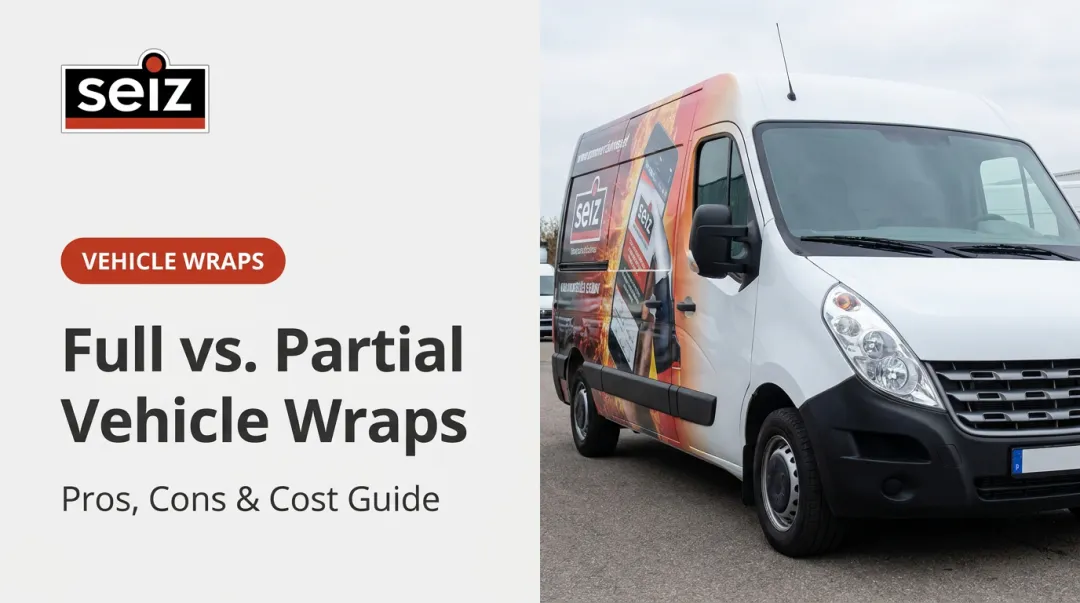
Fleet graphics and fleet wraps are both ways to brand a vehicle, but they use coverage differently. Fleet graphics can include individual pieces of vinyl - such as lettering, decals, and partial graphics - applied to specific areas of the vehicle. A wrap uses a larger, continuous design to cover more of the vehicle's surface.
That difference affects how the branding looks and how the design needs to work with the vehicle. Individual graphics can be positioned around doors, handles, and other features. A wrap has to account for those same breaks while keeping one larger design visually connected across the vehicle.
There's another detail worth knowing when comparing options: "partial wrap" doesn't describe a standard amount of coverage. One provider might cover the doors and rear of a vehicle, while another might cover only a few panels. Two vehicles described as having a partial wrap can therefore end up looking very different.
So when comparing fleet graphics and wraps, don't start with the label. Start with the panels being covered. That's what tells you what you're actually getting.
| Aspect | Fleet Graphics | Fleet Wraps |
|---|---|---|
| Coverage | Specific areas such as doors, windows, rear panels, or tailgates | Larger areas of the body treated as a continuous surface |
| Typical elements | Logos, contact info, service lines, safety marks, USDOT numbers, window film | Full or partial printed vinyl on doors, hood, sides, and rear |
| Best for | Mixed fleets that need flexible, role-based branding vehicle by vehicle | Units that benefit from near-complete body coverage and strong visual impact |
| Cost and coverage | Scales with how many panels and how much print area you need | Higher material and labor per unit; stronger billboard effect |
| When to prioritize it | When identification and readability matter more than full-body color control | When maximum surface area, paint protection, or a locked-in look matter on high-visibility units |
In short: wraps are one tool inside fleet graphics. Choosing only "wrap vs. no wrap" skips the planning work that keeps a mixed fleet looking like one company.
5 Factors to Compare When Choosing Fleet Graphics or Fleet Wraps
The right treatment can be different from one vehicle to the next. A service van that spends all day in residential neighborhoods has a different job from a pickup that spends most of its time on the highway.
That means the decision isn't simply wrap or graphics for the whole fleet. It's about how much coverage each vehicle needs, what the branding needs to communicate, and how the vehicle will actually be seen.
Work through these factors for each vehicle, then decide where full wraps, partial coverage, or lettering make the most sense.
1. How Much of the Vehicle Needs to Be Branded?
The first question is how much of the vehicle your branding actually needs. A simple logo, phone number, and website can work well as targeted graphics. A more involved design may need the continuous coverage of a custom vehicle wrap or full custom wrap to keep the message clear. Two things usually determine how much coverage makes sense:
How much information the design needs to carry: Simple branding can sit comfortably on individual doors, panels, or other high-visibility areas. Photography, illustrations, multiple service messages, or a full color change need more continuous space. With too little coverage, the design can get broken up by doors, handles, windows, and body lines.
How much usable space the vehicle gives you: Not every part of a vehicle is equally useful for branding. Windows, handles, wheel wells, seams, and other breaks can interrupt a design. A fleet graphic may give you plenty of space for a simple identity, while a more detailed design may need the larger uninterrupted surfaces a wrap provides.
The goal isn't to cover as much of the vehicle as possible. It's to give the important parts of your message enough space to be seen clearly.
A simple identity may only need a few strategic panels. A more complex brand message may need the vehicle to become one continuous canvas.
2. Cost vs. Coverage
More coverage means more material, more preparation, and more time on the vehicle.
But the amount of vinyl isn't the only thing affecting the price. The finishing work can make a significant difference too. Bumpers, trim, recessed hardware, and other difficult areas take more time to prepare and install than a large, flat panel. Two trucks that look nearly identical in size can therefore require very different amounts of labor.
That's why comparing a fleet graphic and a wrap based simply on how much of the vehicle is covered can be misleading. A partial graphic may cover less surface but still require careful work around complex areas, while a larger wrap may provide more branding space for a relatively straightforward design.
The better question is what you're getting for the coverage you're paying for. If a few strategic panels are enough to make the brand visible and recognizable, a full wrap may add cost without adding much value. If the design needs more space to work, the additional coverage may be worth it. Compare the cost against the usable branding space, not just the percentage of vinyl on the vehicle.
3. Durability and Vehicle Use
How a vehicle is used should influence the material and finish just as much as the design. A truck that spends all day outside at a job site faces different conditions from a van that spends most nights parked indoors, even if both vehicles travel the same roads. A few factors can affect how the graphics hold up:
- Sun and weather exposure: Consider not only where the vehicle drives, but where it is parked overnight. Long periods in direct sun and changing weather conditions can affect the film over time.
- Road debris and mileage: Vehicles that spend more time on highways or job sites take more impact from road debris, particularly along lower panels.
- Wash method: Regular washing is part of fleet maintenance, but some methods are harder on installed film than others. Film also needs adequate curing time before the vehicle is washed.
- Light conditions on the job: For crews working roadside or after dark, reflective film can be a practical visibility consideration rather than simply a design choice.
How the graphics are installed and maintained matters to their long-term performance.
The right material isn't necessarily the most expensive option. It should be suited to the vehicle that will put it through the most demanding conditions.
Seiz Signs handles installation with its own crews and can take care of repairs and removals later, so the same team can stay with your vehicles beyond the initial application.
4. Vehicle Type and Body Shape
The type of vehicle matters because not every body gives your branding the same amount of usable space. A long, uninterrupted panel gives a designer very different options from a vehicle where the branding has to cross multiple surfaces.
Cargo vans: Long, uninterrupted sides give you one of the easiest surfaces for larger graphics and more detailed branding.
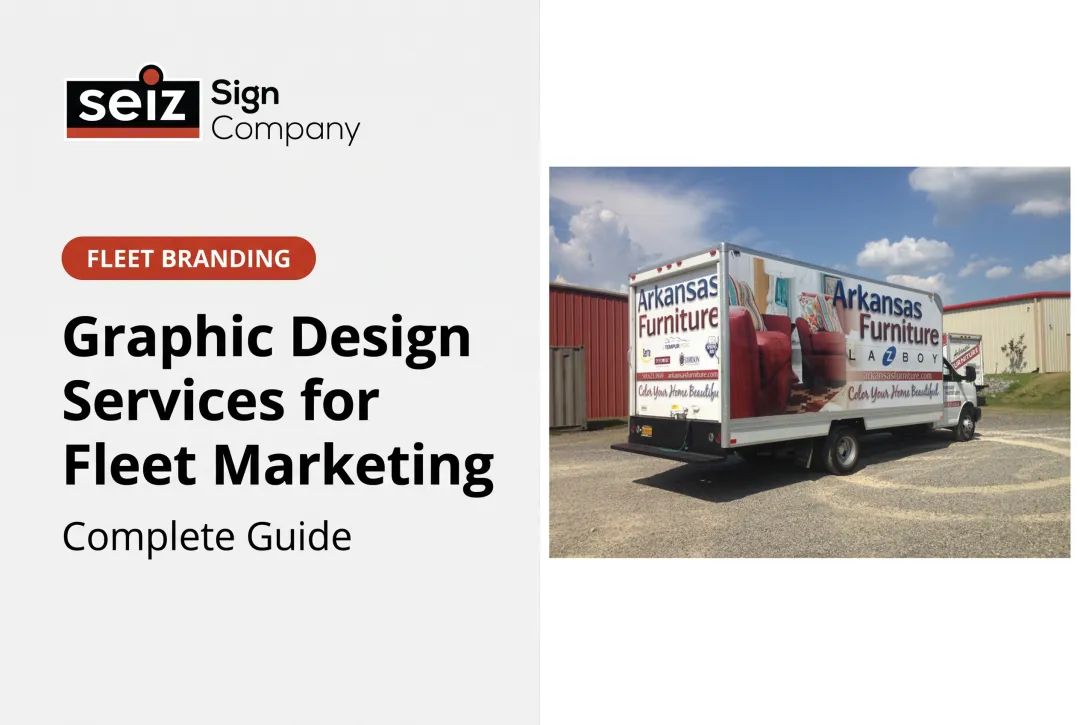
Box trucks: Large, continuous sides provide plenty of space for a prominent message and are well suited to designs that need more room to work.
Pickups: Branding is spread across the doors, bed sides, and tailgate, so the design needs to work across several separate surfaces.
This is easy to miss when approving artwork on a screen. A digital mockup can make every vehicle look like a clean rectangle. Once the design is applied, doors, bed lines, handles, and other breaks can divide the message in ways that weren't obvious in the original layout.
That's why the design should be considered around the way the vehicle is actually seen on the road, rather than treating every available panel as equal branding space.
5. How Often Your Message Changes
Fleet branding isn't always permanent. Businesses add services, change what they want to promote, expand into new markets, refresh their brand, or acquire another company. If those changes are likely over the life of the vehicle, it is worth thinking about how easily the graphics can be updated.
Modular treatment: Specific messages or branding elements are kept in separate graphic areas, so they can be replaced without redoing the rest of the vehicle.
Continuous composition: When the messaging is built into one large, continuous design, changing one element can mean replacing a much larger section of the wrap.
This becomes particularly important for fleets that evolve over time. A company may add a new service this year, retire one next year, or change the way it wants a particular division represented. If that information is built into a full-vehicle design, a small business change can become a much larger graphics job.
That doesn't mean a modular design is always better. If the brand and message are stable, a continuous wrap can create a stronger visual presence. The point is to think about what is likely to change before deciding how permanently it should be built into the design.
Getting More Value From Fleet Branding
A branded vehicle isn't just another company expense. Every time it leaves the lot, it puts your business name in front of potential customers. But not every vehicle earns the same kind of exposure, even when the vehicles themselves are identical.
Consider two vans in the same fleet. One spends most of its day parked in residential driveways. The other spends most of its time on the highway between depots.

Same van. Different job.
The van parked in driveways can be seen at reading distance for hours. Someone walking past can read the phone number. A neighbor can notice the company name. A homeowner can look at the services listed on the side.
The highway van gets a very different kind of exposure. Drivers may only have a few seconds to register it, and at that speed, the largest element on the vehicle is what matters most.
That difference changes what the graphics need to accomplish:
- Parked vehicles can carry more detail: When a vehicle regularly sits in front of homes, businesses, or job sites, people have time to take in a phone number, service list, or other supporting information.
- Highway vehicles need immediate recognition: When the vehicle is mostly seen in motion, the logo, business name, and core message need to register quickly. Smaller details may never get read.
- Routes determine who sees the brand: A vehicle working through residential neighborhoods reaches a different audience from one traveling between cities or distribution centers. The value comes from reaching the people who could actually become customers.
- Parked time is advertising time: A vehicle doesn't stop working as advertising when it stops moving. In some cases, hours spent outside a customer's home or at a busy job site can create more useful exposure than the same hours spent on the highway.
This is why applying the same coverage and design to every vehicle in a fleet can leave value on the table.
The vehicle isn't the audience. The way it is used determines what the branding needs to do.
If you're not sure how much coverage or detail makes sense for your fleet, talk to Seiz Sign Company. Our team can look at how your vehicles are used and help determine the right approach for each one.
How Do You Keep Fleet Graphics Consistent Across Different Vehicles?
Fleet consistency doesn't mean putting the same artwork on every vehicle. It means keeping the brand elements consistent while adapting the layout to the vehicle in front of you.
A cargo van, pickup, and box truck don't give a designer the same surfaces to work with. Stretching one design across all three can leave the logo at the wrong scale, break the alignment, or put important information across handles, seams, windows, and other hardware. The goal is to keep the brand recognizable while giving each vehicle a layout that actually works.
| Keep consistent | Adapt |
|---|---|
| Approved logo treatment and brand colors | Logo scale and exact placement |
| Typography and visual style | Artwork crop and panel distribution |
| Core message order | Amount of graphic coverage |
| Primary identification and contact block | Supporting service message and use of glass |
The best approach is to create a fleet branding standard, rather than a collection of unrelated vehicle designs. That standard can define the approved logo treatments, colors, typography, required copy, and the order in which information should be read. Each vehicle can then have its own production layout built around those rules.
Vehicle-specific templates help resolve the practical differences between models before anything goes to production.
At Seiz Signs, these are the same principles we work through when planning graphic design for fleet marketing.
Version control matters, too. Keep approved artwork organized by make, model, and year, and record which version was used on each vehicle. Maintain one current package for logos, fonts, colors, and required copy. When a replacement truck arrives, the team can adapt the current standard instead of digging through old files and accidentally bringing back artwork that was retired years ago.
There's one simple test for whether the system is working: can the brand still be recognized when the vehicle changes? If the identity only works on one large, flat side panel, it isn't flexible enough for a fleet.
The strongest fleet systems have a clear visual hierarchy that can be adapted to different vehicles without losing the things that make the brand recognizable.
Because eventually, there will be a new truck parked beside the old ones. It should look like it belongs to the same company.
Which Fleet Branding Approach Fits Each of Your Vehicles?

You can run different coverage levels across the same fleet without breaking the brand. Mixing full wraps, partial wraps, and lettering is normal, and often smarter than applying one policy to every unit. Match the treatment to what each vehicle does:
- Small fleet with matching vans - if the factory color already works for you, a partial treatment gets them reading as a set. The goal is recognition across the group, not maximum coverage on any one van
- Mixed fleet acquired over several years - lock the visual rules first, then let coverage vary by vehicle. Do it in that order, and different makes and model years stop looking like separate branding projects
- High-visibility service or delivery vehicles - these represent you in front of customers all day, so they justify commercial truck wraps or fuller treatments before anything else in the fleet does
- Internal or lower-visibility support vehicles - clear identification is the entire requirement. Lettering does that job
The sequence matters more than the list. Decide each vehicle's treatment when it enters the fleet, not when you finally get around to branding a batch of them.
A truck that runs unbranded for four months is four months of a mismatched fleet, and it's far easier to approve a layout against a standard you already set than to invent one under pressure.
Fleet Graphics and Vehicle Wraps in Arkansas With Seiz Sign Company
For an Arkansas fleet, Seiz Sign Company can take the work from a per-vehicle plan through to installed graphics without treating each truck as a separate project.
- Design and templating - Vehicle wrap design services plan each layout around the vehicle it's going on, so what you approve on screen is what arrives on the panel
- Material specification - we specify the film and laminate for how the vehicle is actually used, then handle sourcing to that spec
- Installation and rollout - Professional vehicle graphics installation by our own installers applies full wraps, partial wraps, lettering, and fleet graphics, and can coordinate several vehicles so your fleet doesn't drift out of step while it's being branded
That matters most when your fleet spans different models and coverage levels, which is where most fleet branding quietly comes apart.
Get it right, and the newest truck on the lot is the one nobody looks at twice. It just belongs, the same way the others do.
Ready to plan fleet graphics for your vehicles? Call Seiz Sign Company at (501) 623-3181 or request a custom quote.
Frequently Asked Questions
Can you combine fleet graphics and wraps across the same fleet?
Yes, and most established fleets do. A flagship vehicle can carry a full wrap while the rest of the fleet runs partial coverage or lettering. What holds it together is keeping the recognizable brand elements identical across every unit, so the coverage level varies, but the identity doesn't.
Can you start with fleet graphics and upgrade to wraps later?
Yes. Lettering or spot graphics can be removed and replaced with fuller coverage on the same vehicle. Two things make that transition cleaner: keep your source artwork and brand rules from the first round, and check the paint condition underneath before the upgrade, since sun exposure on uncovered panels can leave visible differences.
Do all vehicles in a fleet need the same type of graphics?
No. A fleet can use different coverage levels while maintaining a consistent brand. The vehicle's body shape, role, route, and visibility can all influence whether lettering, partial coverage, or a full wrap makes more sense.
What information should be on fleet vehicle graphics?
Prioritize what someone needs to understand your business quickly: the company name or logo, a short description of the primary service where it isn't obvious, and one contact point or action. Adding a second phone number, a full service list, or social handles competes with the main identity and usually means none of it registers.